1
Trainer Team Lab: Research, Design, Apply
Trainer Team Lab: Research, Design, Apply
Про
In this activity, you will work in an international team, based on your shared interest linked to the competences of teamwork of trainers.
Your mission is to explore real needs and available resources and transform them into an educational activity/resource, which can be used by other trainers individually or in team.
What will you learn?
- How to analyse needs in trainer teams
- How to map and use resources for learning design
- How to create engaging educational activities and Open Badges on https://trainersappraisal.com/
- How to support cooperation in international teams
- How to turn research into practical learning tools
You will begin by unpacking your topic - defining what you want to learn and what others need to learn. You will then investigate:
- What are the needs of trainers working in international teams
- What resources, tools and methods already exist and what's missing
- How teams can practically address challenges in teamwork
Your research should include:
- Input from other participants (your colleague trainers)
- External online sources
- Reflection on your own experiences
Based on your findings, you will design an Open Educational Resource or an activity on the Trainers Appraisal platform. It should have:
- Clear learning content
- Useful resources (articles, tools, methods)
- Practical exercises or methods that trainer teams can use
Additioanlly, you will design a digital Open Badge to recognise learning based on your created resource/activity.
This activity follows principles of experiential learning. The teams can practice principles that they recommended previously and apply to their own teams:
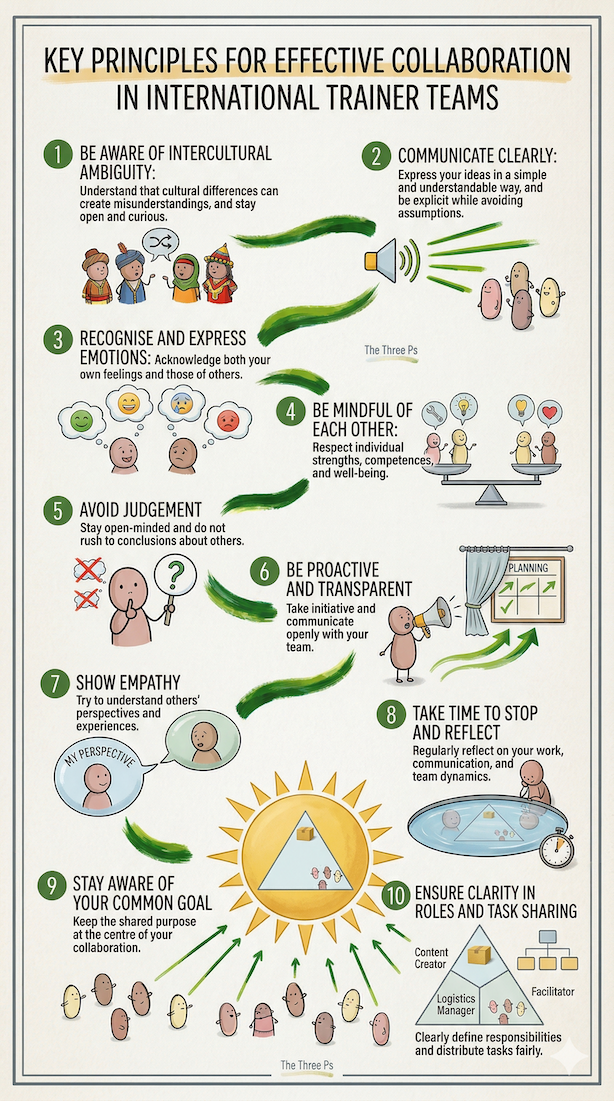
Content: participants of the ToT "Cooperating Successfully in Teams" (2026), Image by Gemini AI.
Evaluation of Your Teamwork
It's time to evaluate your teamwork in creating activities and resources together. Recommended method:
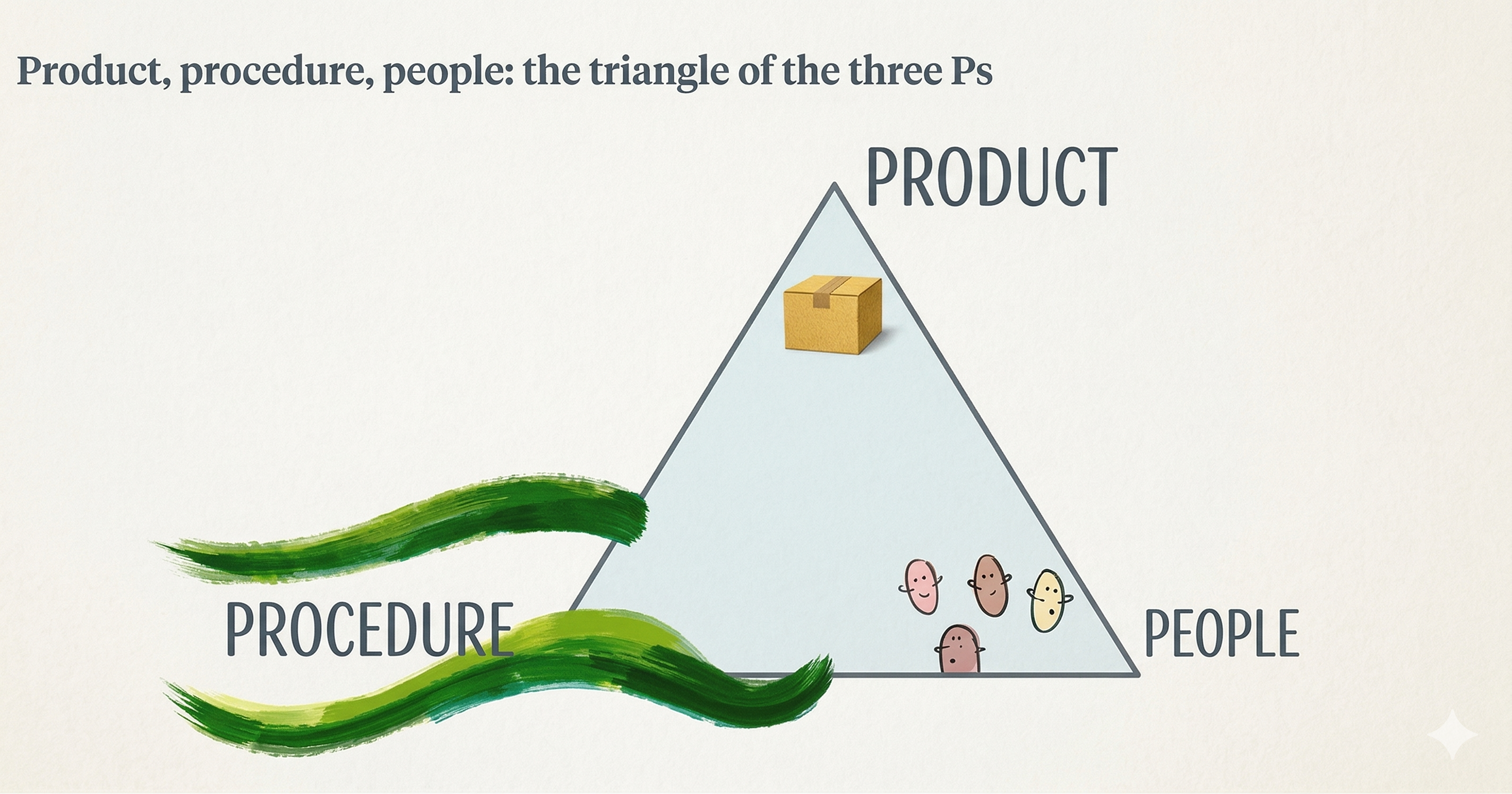
3P – Product, Procedure/Process and People
The triangle of the three Ps – product, procedure and people – represents the different poles that any team needs to consider in its work and ensure there is a healthy and harmonic balance between the three aspects.
At first, remember and reflect on your team experience: the preparation, discussions, collecting resources, uploading to the platform and finally, delivery of the resource or activity as well as the feedback you got from other participants.
People: To what extent does every team member feel able to contribute their unique perspective and fulfil their own role? How did we handle the "human" side of the work? Did we support each other? During high-stress Do we leave this experience feeling energised or drained by the collaboration?
Product: To what extent did the final "product" actually meet the objectives we originally set out to achieve? Looking at the feedback from participants, which specific parts of our "product" were most relevant, and which fell short of their needs?
Procedure/Process: How well did our internal "logistics" (time management, division of tasks, and decision-making methods) support or hinder our cooperation in this team?
Steps to use the 3P model for evaluation
- Draw a big 3P triangle on the A3 paper
- Each member of the team scores the 3 P’s
- Then each member explains their reasons for the scores
- Have a discussion in the team about lessons learned in your work together, and what you would keep and what you would do differently next time.
- Be ready to share up to 5 (can be fewer) most important ‘lessons’ you took from the international teamwork experience.
Get activity badge
Trainers Resource Creator Get this badge
This badge is awarded for collaboration within international, intercultural teams to research and design educational activities or resources. This badge recognises at least 8 hours of learning experience in an international team of trainers.
The earner has applied the "3P" framework (Product, Procedure, and People) to evaluate the teamwork
By completing the requirements for this badge, the individual has:
- Taken on responsibility for collective outcomes in a trainer team lab environment.
- Contributed to the design and application of educational tools.
- Involved others, seeking to integrate diverse perspectives into the final product.
- Learned with and from others through reflection on intercultural ambiguity and team dynamics.
The Awero organisation created this educational resource and activity for the Erasmus+ Accreditation training for trainers. Activity content and badge issuing criteria aligned with the European Training Strategy (ETS) competence model for trainers working internationally.
Learning duration: at least 8 hours
Tasks
Task no.1
Evidence verified by: one activity organiser
Evaluate your teamwork experience using the 3P Triangle model to reflect on the balance between the product, the process, and the people involved.
Share a brief summary of the most important 'lessons' you learned about collaborating and contributing within an international trainer team.
(We recommend using the Badge Wallet app to upload the evidence text)
Skills
ETS-TR
#Contributing actively to team tasks
ETS-TR
#Being willing to take on responsibility
ETS-TR
#Encouraging and involving other team members
ETS-TR
#Learning with and from others
Організатори
Awero
Badge issuer recognized with

Awero not-for-profit organisation manages this platform and develops it together with leading educational organisations. The European Union's programme Erasmus+ granted co-funding for building the first version of this platform. Contact support@awero.org.
Platform
Discover
Change to another language: